
Hrudka – Ukrainian Egg Cheese



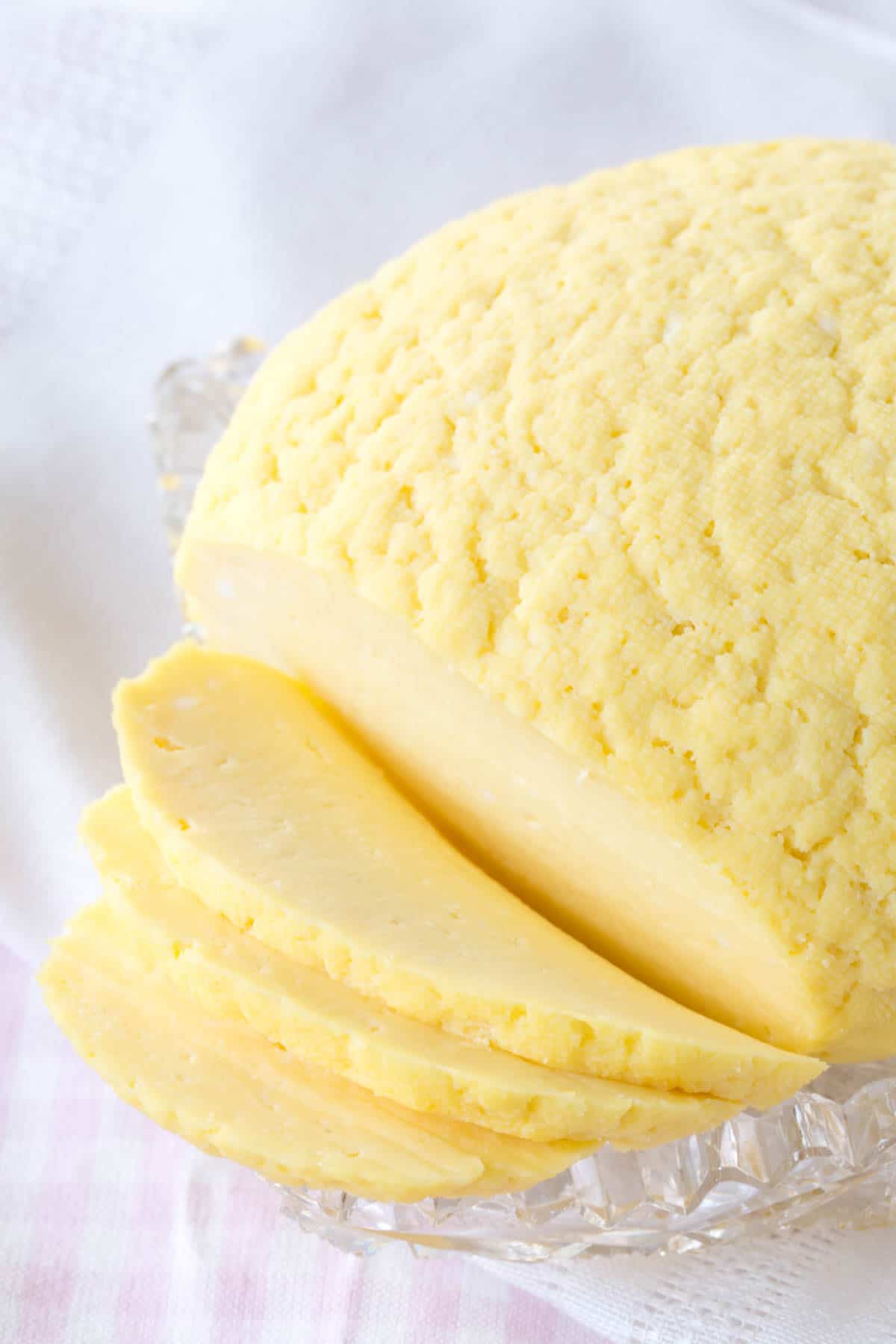
Hrudka is a Ukrainian Easter cheese made from eggs, and this is the recipe that has been part of my family’s Eastern European holiday tradition for generations. Egg cheese is a traditional Ukrainian Easter food that is always part of our Slovak Easter menu.
Delicious Details
- Cuisine Inspiration: Ukrainian
- Primary Cooking Method: Stovetop, Oven
- Dietary Info: Gluten-free
- Skill Level: Moderate
Hrudka – Ukrainian Easter Cheese Recipe
If you are Ukrainian, Polish, Slovak, or of other Eastern European descent and want to connect with your roots, or just like trying new and unique recipes from different regions of the world, give this Hrudka recipe a try. It’s easy, fun, and pretty awesome to say that you made your own cheese!
This cheese is one of the Ukrainian Easter foods that we put in our Easter basket to be blessed at church on Holy Saturday. Each one has a significance. The homemade bread is a symbol of Jesus, the Bread of Life. Horseradish is usually mixed with beets and the color is a symbol of the blood he shed for us. Eggs are a symbol of new life and the rebirth of Christ. A candle is lit to symbolize the Light of the World.
Cheese is also symbolic of the moderation Christians should have in their lives. Combine that with the symbolism of the Easter egg, and it only makes sense to make cheese out of eggs for this holiday.
It is definitely something different, and, from what I can find, unique to Eastern Europe. A Google search for “egg cheese” turns up lots of cheese eggs, but really only Hrudka as actual cheese made from eggs.
What Does Hrudka Taste Like?
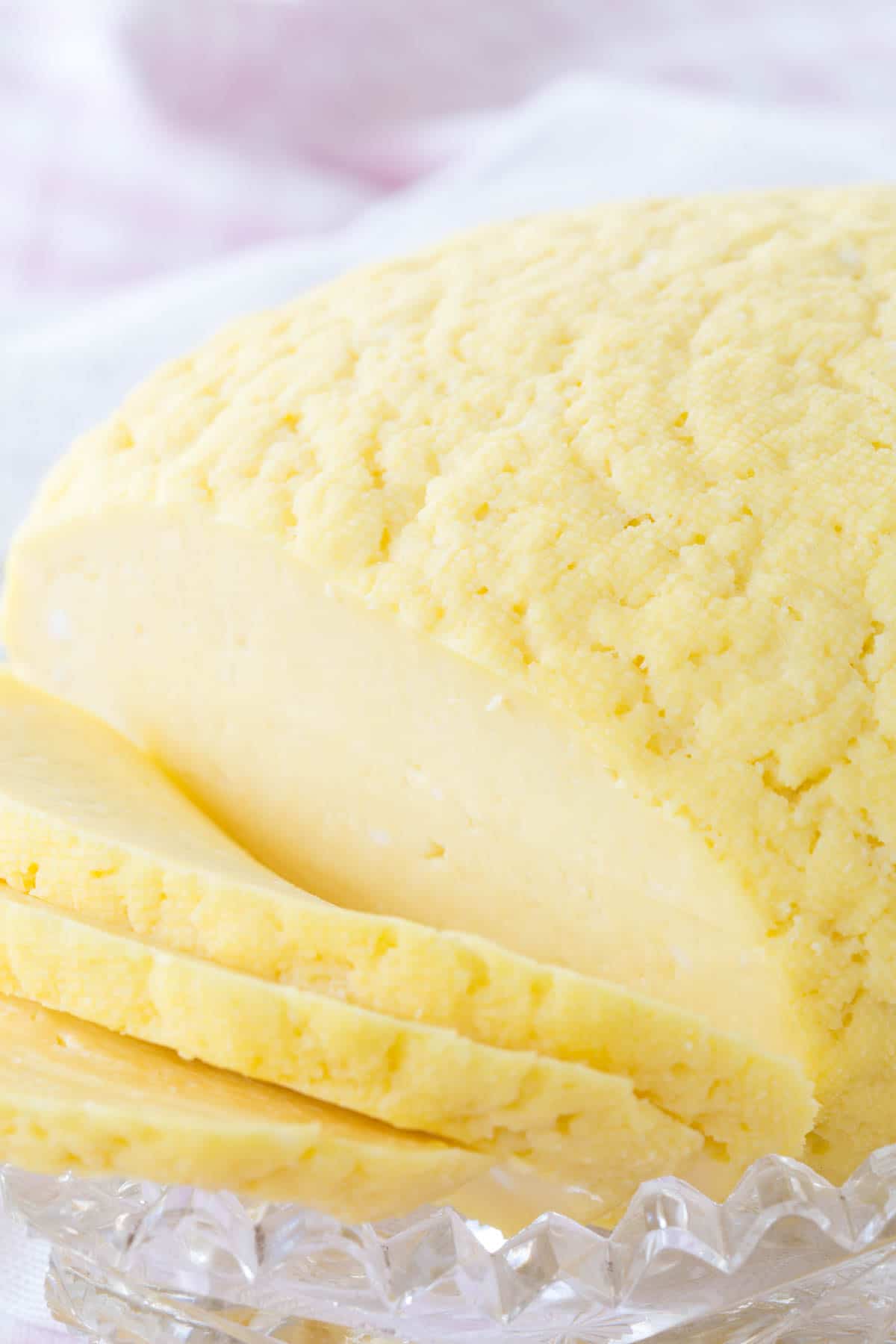
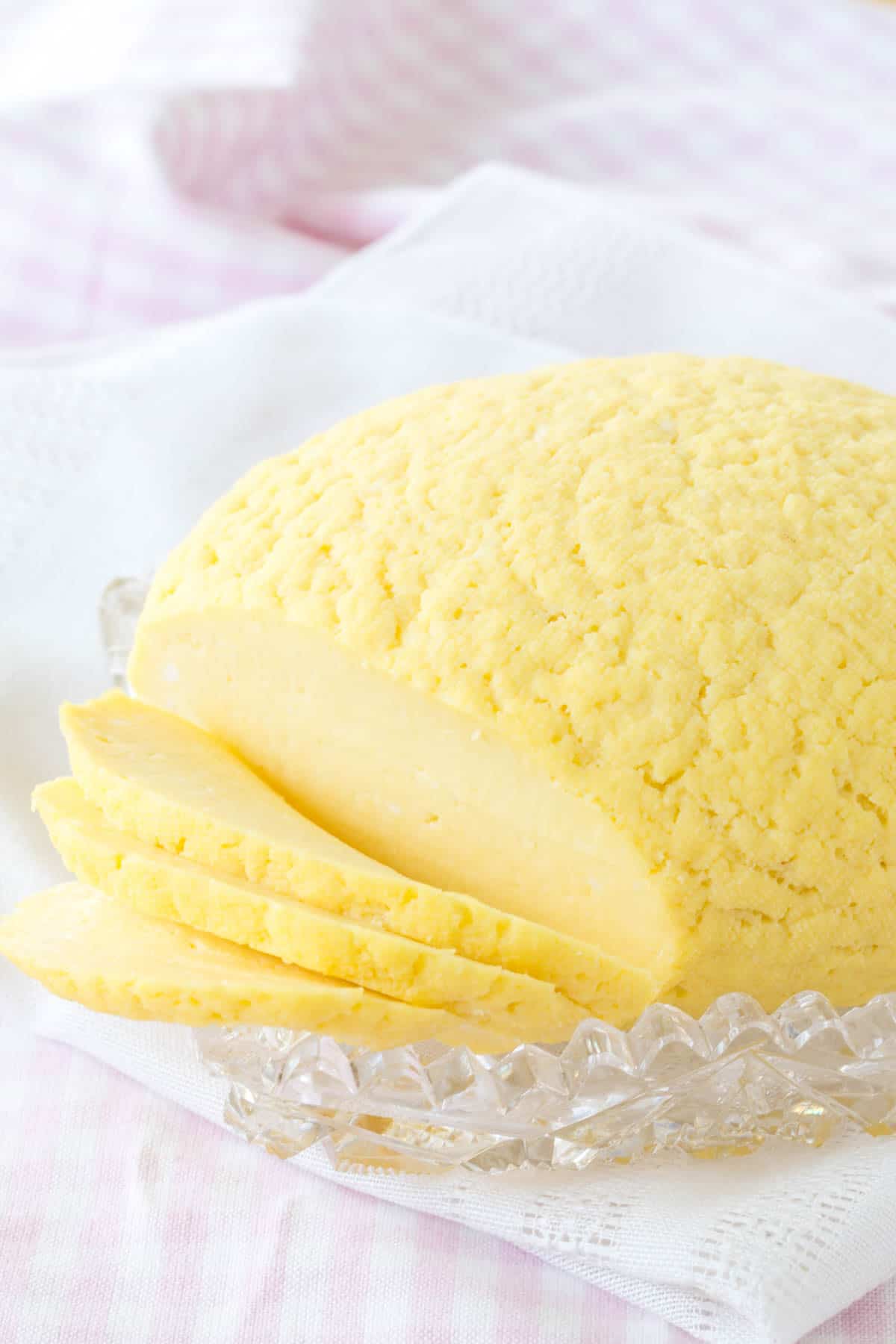
In our family, while my mom was helping my grandma make Paska, my aunt was making the Easter cheeses – the sweet Syrnyk, and this one. While it may be called “egg cheese” it does not taste like scrambled eggs or cheesy eggs. It’s smooth and slightly sweet, and not quite as salty as other cheeses. It is definitely milder, not like a sharp cheddar, and perhaps more similar in texture to mozzarella. And it goes well along with an Easter ham.
Recipe Ingredients
You only need four ingredients to make this Ukrainian Easter food. Here’s a list of what you’ll need for my family’s hrudka recipe. Keep reading for some tips, then scroll to the recipe card for the full amounts and step-by-step instructions.
- Eggs. You’ll need a full dozen.
- Whole milk. I do not recommend using low-fat or skim milk.
- Sugar. This is not a sweet dessert cheese, but there is a little sugar for a hint of sweetness.
- Salt. Just a little as a flavor enhancer.
Tips for Success
- Have the items you’ll need. For the most part, you just need standard kitchen items, like a pot, a whisk, and a heat-proof bowl (glass is fine), as well as a shallow baking dish. But make sure you have cheesecloth, as this is essential for straining the whey to form the ball of cheese.
- Know what to look for. While you do need to use a bowl set over a simmering pot of water as a double boiler versus direct heat to avoid overcooking the mixture, you do want to cook it long enough. It’ll take about 20-30 minutes for the curds to separate from the whey, and it’ll look similar to scrambled eggs.
- Strain fully. You’ll need to keep the cheesecloth wrapped tightly around the cheese to drain for several hours or overnight in the refrigerator to ensure all of the whey has drained off.
Storing Homemade Cheese
The Hrudka should be kept covered in the refrigerator. It is best enjoyed within 2 to 3 days. I do not recommend freezing Hrudka.
More Ukrainian Easter Recipes
- Paska – Ukrainian Easter Bread
- Pot Cheese and Potato Cheese Pierogi (my recipe is gluten free!)
- Syrnyk – Sweet Ukrainian Easter Cheese
You can also try Haluski or Fried Cabbage and Noodles from A Family Feast. Sweet and Sour Cabbage Rolls from Noble Pig are always a classic. And though more popular around Christmas than Easter, you can’t go wrong with Nut Roll from Brown Eyed Baker.
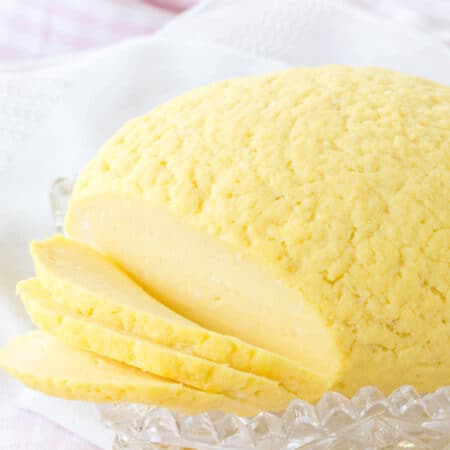
Hrudka – Ukrainian Egg Cheese for Easter
Ingredients
- 12 large eggs
- 1 quart whole milk
- 2 Tablespoons granulated sugar
- 1 teaspoon salt
Instructions
- Line a strainer with cheesecloth and set aside.
- Combine 12 large eggs, 1 quart whole milk, 2 Tablespoons granulated sugar, and 1 teaspoon salt in a heat-proof bowl or the top of a double boiler and whisk until combined.
- Place bowl over a pot of water or assemble the double boiler and, over medium heat, bring the water to a simmer. Cook, stirring very frequently, until the mixture begins to thicken and then the curds separate from the whey. This will take 20-30 minutes from when you start to see the curds begin to form, and it will look similar to scrambled eggs when it is done.
- Pour the mixture into the cheesecloth to drain off the liquid (the whey), and allow to drain for several minutes. Then gather the cheesecloth, forming the cheese into a ball and squeeze out as much liquid as possible, allowing to cool until you can handle it, if necessary.
- Keeping the cheesecloth wrapped tightly around the cheese, drain for several hours or overnight in the refrigerator.
- Preheat the oven to 350°F and place the cheese in an oven-safe dish. Bake for about 30 minutes or until golden.
- Cool completely in the refrigerator before slicing. Serve with your Easter ham.
Did you make this?
Leave a star rating to help others know that they should make this recipe.
Share a photo and tag @cupcakesandkalechips on Instagram!
My mother’s family was Slovak. We made the Easter cheese every year, but we called it “Cirek .” Ours was not baked in the oven after draining it . We refrigerated it and ate it with our nut roll and poppyseed roll on Easter morning.
My mom used the liquid from draining the Easter cheese in yeast dough—some in the Paska, some in the nut and poppyseed roll dough, and if she had any left, she froze it and used it at some other time when she baked bread.
I
Thank you for sharing your traditions! I actually think my great-grandmother used to do the same with the liquid from the cheese. But then they started dividing tasks amongst my family and my mom made the Paska while my aunt made the cheese so everything was done separately.
Can you do it in the microwave ? If so, how long ?
Hi Pam. Unfortunately, a microwave won’t work for this recipe. To make Hrudka, the eggs must be cooked very slowly and gently so that the curds can form.
I make my Hrudka in the microwave every year and it turns out great!!!!!
Interesting!
Does it actually taste cheesy? Or just like smooth, sweet eggs? The texture in the pictures and the description are making me think of tamagoyaki, Japanese omelet commonly used in sushi. Could you slice it for an egg sandwich?
You know, it’s hard to describe the flavor. It’s not super sweet and it does have a bit of a cheesy flavor. It’s not overly eggy. I have not heard of tamagoyaki. The Hrudka is typically sliced, but in my family we have not used it on sandwiches. I suppose you could.
My mom’s family has been making this forever, too! Our recipes are the same, also. We just wish there was a device to form & squeeze the egg ball, instead of scalding our hands & cutting fingers on the string as we tie it tight?
Wouldn’t that be a nice little miracle, Christina? 😉
I am Ukrainian and Polish and have never had this. Will have to give it a go. Would a “nut milk bag” work rather than cheese cloth?
I think it might, but I have not tried that. I don’t know exactly how porous the nut milk bags are.
My mom was Slovak, so I also grew up eating this at Easter. However, we didn’t bake it in the oven. Also, my mom added a little sugar and cinnamon. I made it for the first time yesterday. Does anyone know if it can be frozen? Thanks so much!!! I love seeing traditional recipes. Thanks for posting!
I have seen it with cinnamon and have heaerd of versions not baked. I guess everyone has their own family recipes 🙂 I have a feeling it wouldn’t freeze very well, though I don’t know that anyone in my family has ever tried.
I have never heard of this…so very interesting!.
It’s a classic dish at our house, Cathy. I think it’s fun to try new ethnic recipes once in a while!
My family has been making this for over 100 years!!! My great-grandmother was born in 1889, and her mother and grandmother made it! (If I calculate her grandmother being age 50 in 1889, that’s 178 years!!!!) I remember my great-grandmother making this, and the same for my grandmother, my mother and father, my sisters and I, and now my children!
Our recipe differs slightly . . .
Instead of a quart of milk, we use one cup of milk, and 1 1/2 pounds of ricotta cheese. Years ago, a similar cheese was used that cannot be found now, but I don’t remember the name of it.
Also, one egg yolk is retained and put aside. Before baking, the yolk is broken on top and rubbed around the outside.
It’s DELICIOUS, and easy to make!
After my father had a triple bypass, I made one for him with (don’t gag!) Egg Beaters and skim milk . . . I know . . . It’s sacrilegious in the making of our Hrudka! But, it turned out pretty good!
Your family’s recipe for Hrudka sounds delicious, Laura!
My Dad’s family made this cheese every Easter…they passed this on to their children but it wasn’t passed on to my generation. Thank you for giving me this blessing. I took it to my Grandson’s school for a presentation on Easter traditions (blessing of Easter baskets…they loved it.
I’m so happy to have given you a recipe that you can share with your family, Ella!
I’m Slovak and we’ve been making this since I was a child, however we refrigerate it overnight and just serve it the next day with our ham or kielbasa. What is the reasoning for putting it in the oven? It seems as if it would dry it out. We always serve it with beet horseradish, as an option too! Yum!!
Hi Patricia! I’m not exactly sure why we heat it, but that’s how my family has done it for generations. It’s very good that way, but I guess there are a few different ways to make it! 🙂
Just going over Easter cheese.
I also was surprised u reheated or baked in oven.
My Baba was Slovakian/ Rutherian
And she stirred ingredients of the savory style, and drained into a cheese clothe she hung over the sink w a wooden spoon and as it drained she would continue to twist the spoon in tightening the cheese cloth ball till it no longer drained whey. Then she hung the curd in tge cheese cloth over a bowl or sitting in a collard strainer over a bowl still hanging in the refrig.
On sat/ holy sat before light, she pred her basket for the miring blessing at the church.
We served this at Easter meal after mass.
Straight from the refrig with blessed butter or other items from the basket( red horseradish, pickled beet hard boiled eggs, Easter bread, ham or kielbasa , beets, lamb cake if we had, a white candle was in bread w a colored egg and other colored eggs blessed.
Basically I got confused that this Easter cheese would be reheated as we always served cold.
Thank u for ur site.
Ds
Thanks for sharing your traditions! We do not reheat it to serve ie. We serve it cold, but it is baked in the preparation.
My baba called it “chicken cheese” in English. I made it, oh, maybe 20 years ago for my husband. Glad you reminded me of it, seeing as right now I’m overstocked with eggs from my neighbor.