
Paska – Ukrainian Easter Bread

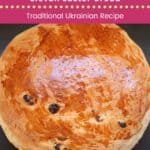
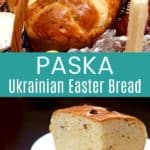
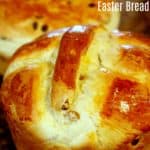
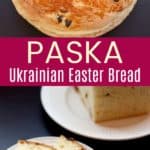
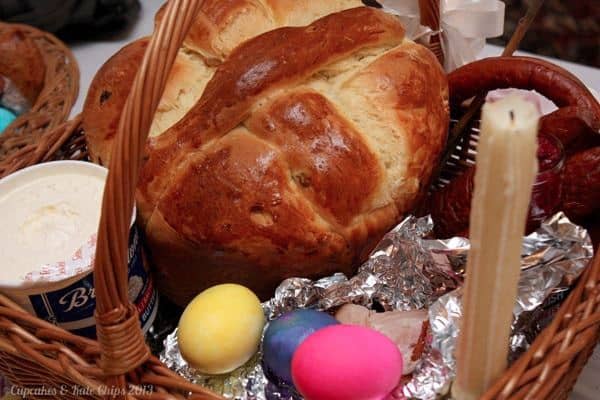
Paska, the Ukrainian Easter Bread is the traditional Eastern European Easter bread recipe made in my family for generations. Similar to a Polish Babka, this Slovak bread recipe with raisins is light and slightly sweet, perfect for slathering with butter as breakfast or alongside your Easter ham and kielbasa.
This recipe has been handed down for generations. In fact, up until a few years ago when my aunt rewrote it, we were working off of a scrap of paper where my grandmother had scribbled out the ingredients and a few vague instructions. The bread is always made on Good Friday, starting fairly early in the morning, blessed on Holy Saturday, and we get to sink our teeth into the first slice on Easter morning.
It started with my Great-Grandma, well before my time, who passed on the recipe to my Grandpa and Great-Aunts. Then Grandma used to make it, but when her rheumatoid arthritis got bad, my mom took over, with my grandma hovering closely to make sure she was doing it right. Now my mom is the pro, and I am learning the ropes. I often helped out as a kid, but now I occasionally get my hands in there a little more so that I know how it feels. My mom has that intuition now, knowing when the dough is just right. I’m honing my skills.
So one of my main reasons for putting this on my blog is not just to share my stories and my family’s recipe with you, but to preserve it for me, my cousins, my sister, and our families and future families. Hopefully I’ll get some better photos this year. Last year I was still a novice with the camera, but they’ll do for now.
As you can imagine, this one is a labor of love. And I am going to describe how it is made, but, as you can imagine with bread recipes and family recipes from the old country, a lot of it is just feel. You’ll notice a couple of the ingredients don’t have a measurement. You know, that’s just the way it is. I do need to get my mom to help me figure out about how much salt goes in, but the raisins truly are just eyeballed. I didn’t like them as a kid, so I always tried to get my mom to add less, so I wouldn’t have so many to pick out. My sister is always begging her to add more. Do as you wish.
Ukrainian Easter Paska Bread Recipe
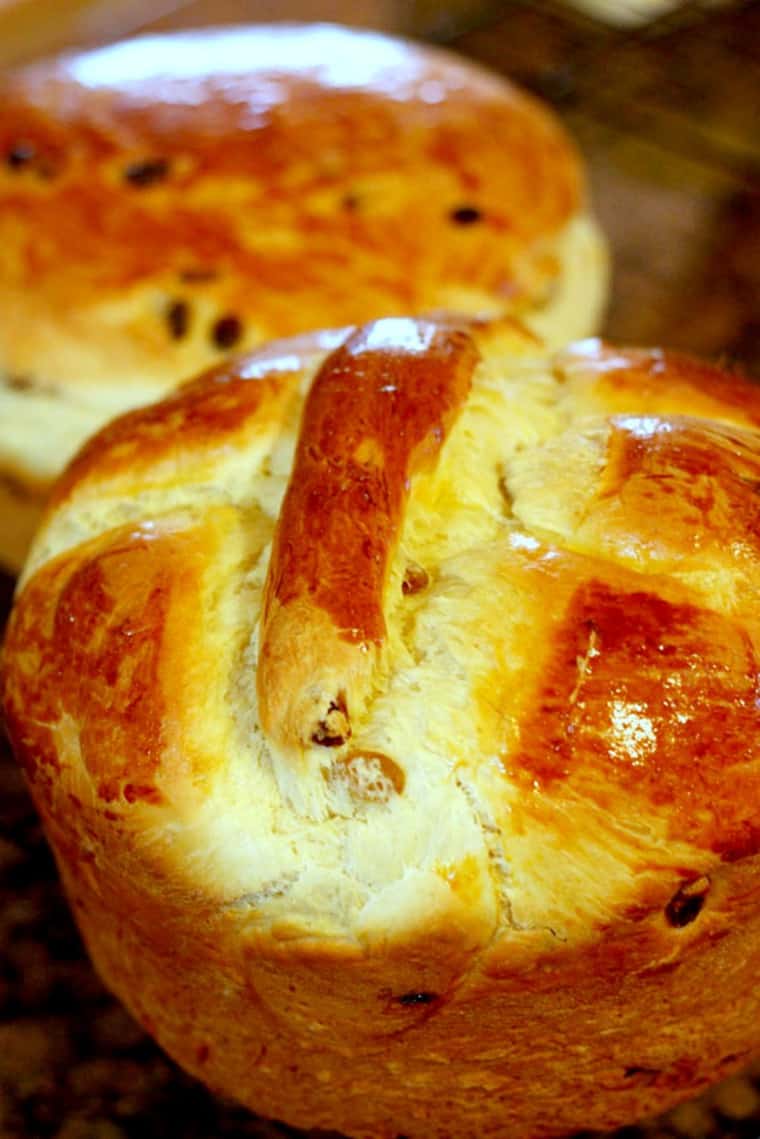
This Ukranian Easter Bread is slightly eggy and subtly sweet and savory, with the bursts of sweet from the raisins. The photos here are from last year, and it was a pretty good batch, but truly it turns out differently every year, depending on the weather conditions, the noise level in the house (if you believe what my grandmother always said), and if there were enough of us gathered around to pray over the dough before the first rise. Some years it is a bit dense, and you really want to slather it with butter. Other years you could just tear into the light, fluffy bread just as it is (unless you are my mother, in which case you still slather it with butter, or my sister who commits the ultimate crime and pops her buttered Paska into the microwave for a few seconds – ugh!).
We like to enjoy it for breakfast, spread with whipped butter. It is also served along with our Easter meal, which is usually a simple meal that always consists of ham, kielbasa, potato salad, hard boiled eggs, and then we usually put together a couple of other side dishes or veggies, like buttery peas and carrots, creamy green beans and mushrooms, or even a simple Maple Dijon Coleslaw.
But before our Paska can be eaten, we take it, along with our Easter ham, kielbasa, butter, eggs, horseradish, and a few other items to church to be blessed. Then once we have celebrated the resurrection of Christ in Easter mass, we can enjoy all these delicious foods.
More Eastern European recipes
- Pierogies – the traditional Polish dumpling filled with pot cheese (aka Farmer’s cheese) or potato cheese.
- Syrnyk – sweet Ukrainian Easter cheese
- Hrudka – Ukrainian egg cheese for Easter
Also, if you have leftover eggs, you can always use them to make Greek Yogurt Deviled Eggs.
Paska – Easter European Easter Bread Recipe
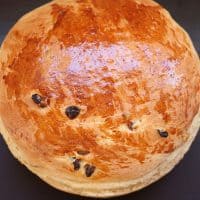
This Slovak Easter bread recipe has been passed down in my Ukrainian family for generations. A slightly sweet egg bread with raisins, similar to Polish babka. Slather it with butter to enjoy for breakfast or with your Easter ham and kielbasa.
Paska – Ukrainian Easter Bread
Ingredients
For the sponge:
- 0.75 oz. (three 0.25 oz. packets) yeast
- 2 cups flour
- 2 cups warm water
For the bread:
- 1 lb. butter (4 sticks)
- 2 cups milk
- 8 eggs lightly beaten
- 1 cup sugar
- 5 lb bag flour plus additional if needed, and for kneading
- salt – no exact measurement, a tablespoon or two
- golden raisins – as many or as few as you like
- 1 egg lightly beaten, for brushing the loaves
Instructions
For the sponge:
- In a very large stock pot, combine all of the sponge ingredients, cover the pot, and let rest in a warm place until bubbly (usually at least an hour).
For the bread:
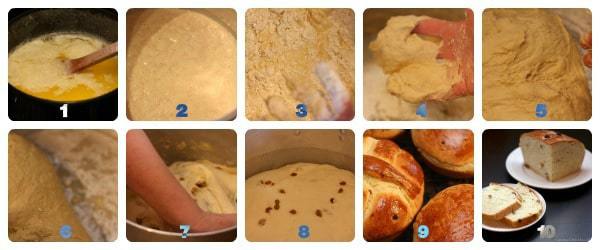
- While the sponge is bubbling, combine the milk and butter in a saucepan, heat to melt the butter and the scald the milk (see photo #2). Let cool to room temperature.
- Once the sponge is bubbly (see photo #2), Add about one-third of the butter/milk mixture, one-third of the eggs, one-third of the sugar, a little less than one-third of the flour, and the salt. Begin mixing with your hands (see photo #3) until combined.
- Add another third of each of the ingredients and mix with your hands until combines. The dough may start coming together a little more at this point (see photo #4).
- Add the remaining butter/milk, eggs, sugar, and gradually add the flour, kneading until the dough pulls away cleanly from your fingers (see photo #5) and the sides of the pot (see photo #6).
- Knead in the desired amount of raisins (see photo #7).
- Put the lid on the pot and allow to rise in a warm place for about 2 1/2 hours, or until at least doubled in size (see photo #8).
- Punch down and raise for another 1 1/2-2 hours, or until again at least doubled in size.
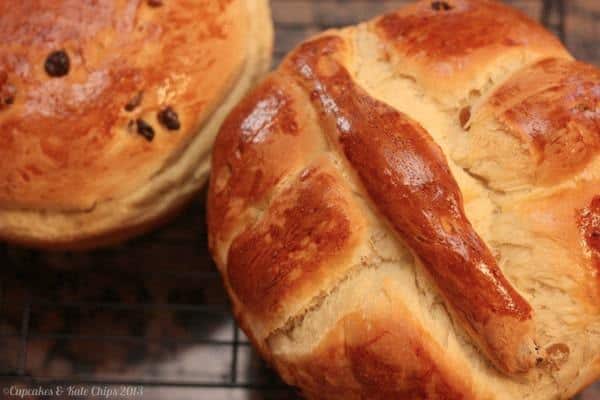
- Punch down, then divide the dough into four high-sided about 9-inch diameter round pans (from what I have seen, I think tube pans will also work, but we don’t do that). If desired, set aside a small amount of the dough, then use this to add decorations to the tops of the loaves. Since it is Easter, we make crosses on a couple of the loaves.
- Lay towels over the loaves and let raise in the pan for about an hour.
- Preheat the oven to 350°F.
- Brush the tops of the loaves with the egg wash, and bake (typically two loaves at a time will fit nicely in the oven at once) for about 45 minutes, or until golden brown, and sound hollow when lightly tapped (see photo #9).
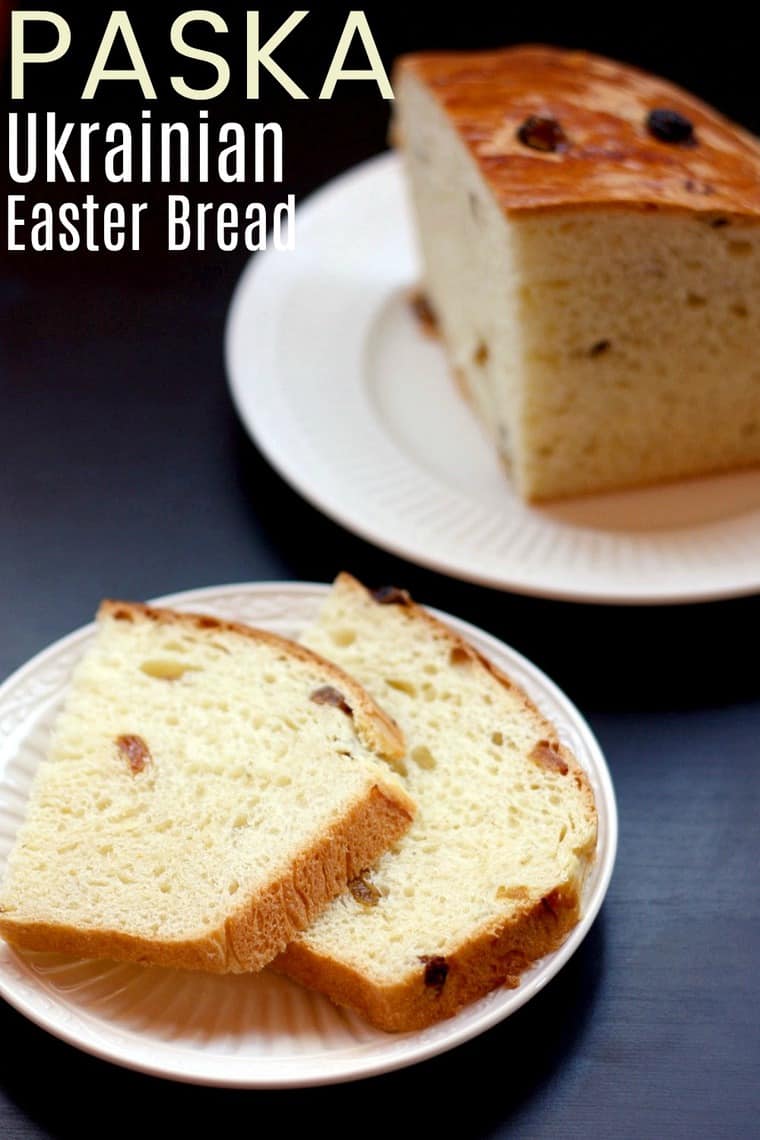
- Allow to cool completely before removing from the pans. Then slice and serve (see photo #10).
Did you make this?
Leave a star rating to help others know that they should make this recipe.
Share a photo and tag @cupcakesandkalechips on Instagram!
This is one gorgeous loaf, Brianne. I love recipes that have been passed down.
You are absolutely amazing… here you are in the hospital and you still manage to join Sunday Supper. I am so happy for you and I sure hope there is still some of this beautiful bread when you get home with that gorgeous baby boy!
Bread that you have wait to eat? Boo haha But I bet it is totally worth the wait! Love the golden brown color. Also that’s awesome you have a family recipe like that. I’m not so lucky.
This is another reason why I blog. Preserving family recipes. These days tradition is something that seems to be dying off and I think that is sad. Keeping old family traditions is something that gives us a history and makes for a much richer future. I love that you have been able to preserve this one for your family and future generations.
That looks amazing! The best recipes are the ones passed down from generation to generation–many of my family recipes are like that with very little instruction and lots of eyeballing!
Never had this before but the ingredients are all good things!
This bread is BEAUTIFUL! I love the story of your tradition and how you are passing it on for your family (and now us!) to enjoy. I am excited to try this, and appreciate you posting it!
What a wonderful, special Easter Tradition!
This post reminds me of my great great grandmother´s recipe for plum pudding scribbled on yellow papers. It was definitely a labor of love, so time consuming. But this recipe is just the kind of sweet fruity bread I love to bake! One more for my collection.
Beautiful! I love the traditions of food and how we can connect to past generations through these recipes. Your bread is amazing and I am sure taste out of this world. Have a Happy Easter.